THE STORY OF THE HOLY MASS CRUCIFIX
The Holy Mass Crucifix was created from a desire to make visible the profound union between Calvary and the Holy Sacrifice of the Mass.
The sacrifice offered by Jesus Christ upon the Cross and the Sacrifice of the Mass are not two separate sacrifices. At every Holy Mass, the one Sacrifice of Calvary is made sacramentally present upon the altar.
“When you see the Eucharist, you see the Body of Christ on the Cross, and when you see Christ on the Cross, you see Calvary.”
The Holy Mass Crucifix brings these realities together in a single visual expression of the Catholic Faith: Christ crucified, the Holy Eucharist, and the sacrificial mystery of the Mass.
THE SYMBOLISM OF THE HOLY MASS CRUCIFIX
Every element of the Holy Mass Crucifix has meaning. Together, they draw the eye from the Sacrifice of Calvary to the Holy Eucharist and the Sacrifice of the Mass.
THE HOLY EUCHARIST
At the top of the Crucifix is the Holy Eucharist, proclaiming that the same Jesus Christ who offered Himself upon Calvary is truly present in the Blessed Sacrament.
The Eucharist draws the eye immediately to Christ and reminds us that the Sacrifice of the Mass and the Sacrifice of Calvary are one and the same Sacrifice.
THE IHS
Upon the Eucharist are the sacred letters IHS, an ancient monogram of the Holy Name of Jesus.
The small Cross rising in the Chalice above the letters IHS joins the Holy Name of Jesus to His Sacrifice upon Calvary and to His Real Presence in the Holy Eucharist.
THE WHEAT AND GRAPES
Wheat and grapes extend across the arms of the Crucifix, representing the bread and wine offered at the Holy Sacrifice of the Mass.
Through the words of consecration, the bread and wine become the Body and Blood of Jesus Christ, making present upon the altar the same Christ who offered Himself upon the Cross.
THE CHALICE
The Chalice represents the Precious Blood of Jesus Christ and the Holy Sacrifice of the Mass.
Placed upon the Crucifix, it reminds us that the Blood offered sacramentally from the Chalice is the Blood of the same Christ who shed His Blood for our salvation upon Calvary.
CHRIST UPON THE CROSS
At the center of the Holy Mass Crucifix is Jesus Christ upon the Cross, the visible sign of His Sacrifice upon Calvary for the redemption of mankind.
Everything surrounding Him points back to that Sacrifice. The Eucharist, the wheat and grapes, and the Chalice remind us that the Holy Sacrifice of the Mass makes present the one Sacrifice of Christ upon Calvary.
THE ST. BENEDICT MEDAL
The expression “St. Benedict Crucifix” is commonly used, but it can obscure an important distinction. There is the Crucifix of Jesus Christ, and there is the Medal of St. Benedict. They are two distinct sacramentals.
The St. Benedict Medal is a sacramental in its own right. It does not require a Crucifix. It may be worn or carried by itself, placed on a key chain, kept in a vehicle or home, or incorporated into other devotional objects. When the medal is attached to a Crucifix, it remains the Medal of St. Benedict; the Crucifix remains the Crucifix of Jesus Christ.
This distinction is deliberately expressed in the design of the Holy Mass Crucifix. The St. Benedict Medal is given an honored place at the bottom, but Jesus Christ remains at the center.
It was not St. Benedict who died upon Calvary. It was Jesus Christ. It is not St. Benedict whose Sacrifice is made present at the Holy Mass. It is the one Sacrifice of Jesus Christ.
St. Benedict, like every saint, received the grace by which he became holy from Jesus Christ. The position of the medal therefore teaches visually what the Catholic Faith teaches spiritually: the saints do not take the place of Christ; they lead us to Him.
The Holy Mass Crucifix places everything in its proper order: Christ, His Sacrifice, and His Real Presence in the Holy Eucharist at the center; the saints pointing us toward Him.
THE INRI
Above Christ appears INRI, the traditional inscription placed upon the Cross of Jesus: “Jesus of Nazareth, King of the Jews.”
The inscription recalls the title placed above Christ at Calvary and proclaims the kingship of the One whose Sacrifice is made present at every Holy Mass.
CALVARY AND THE HOLY MASS
The Holy Mass Crucifix was designed so that these symbols would not be seen separately, but together as one expression of the mystery of the Catholic Mass.
Calvary is not merely an event of the distant past. In the Holy Sacrifice of the Mass, the one Sacrifice of Jesus Christ upon Calvary is made sacramentally present upon the altar.
The Crucifix therefore points simultaneously to the Cross, the altar and the Holy Eucharist — drawing the mind and heart toward the Sacrifice of Christ made present in every Holy Mass.
THE BEGINNING OF THE APOSTOLATE
The Holy Mass Crucifix became more than a design. It became an apostolate — a means of helping Catholics see more clearly the profound relationship between Calvary, the Holy Eucharist and the Holy Sacrifice of the Mass.
Its purpose is simple: to draw attention to Jesus Christ and to deepen love and reverence for His Real Presence in the Holy Eucharist and for the Sacrifice made present at every Holy Mass.
In time, this apostolate would receive an extraordinary encouragement from Rome — an Apostolic Blessing from Pope Benedict XVI.
THE APOSTOLIC BLESSING
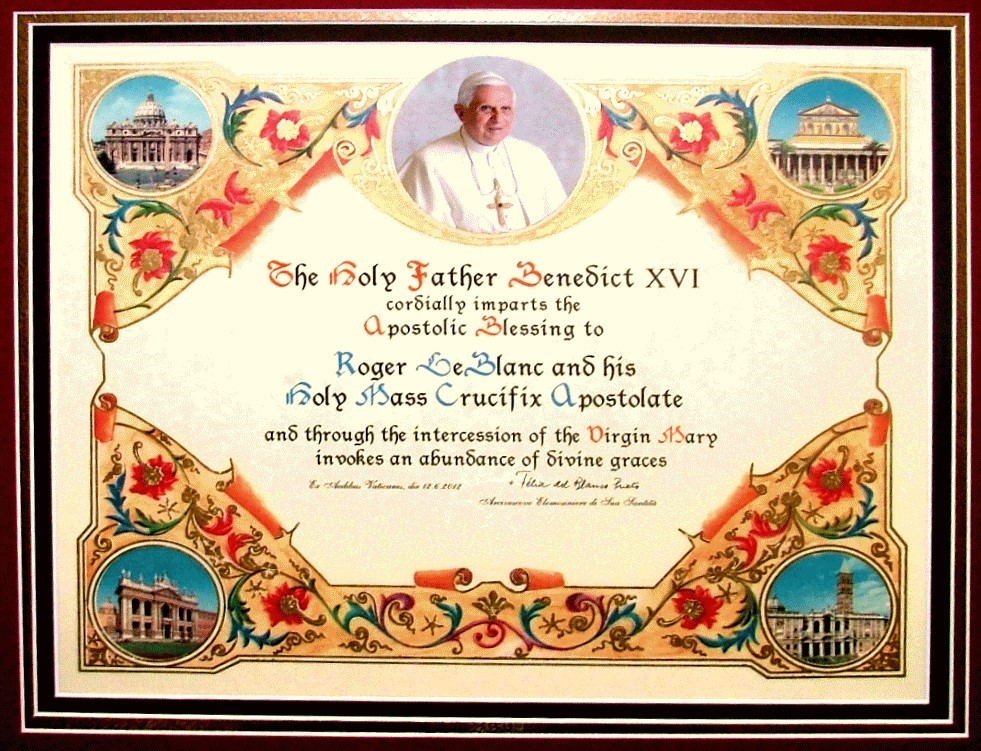
The Holy Mass Crucifix apostolate received a remarkable encouragement when Pope Benedict XVI imparted his Apostolic Blessing to Roger LeBlanc, and his Holy Mass Crucifix Apostolate.
The inclusion of the words “and his apostolate” was especially meaningful because the blessing extends beyond the individual to the Holy Mass Crucifixes themselves and to the apostolate dedicated to spreading their Eucharistic message.
The death of Pope Benedict XVI did not erase the Apostolic Blessing he imparted. It remains part of the spiritual heritage of the Holy Mass Crucifix Apostolate. When each Holy Mass Crucifix is blessed by a priest, the Apostolic Blessing is imparted to that Crucifix, continuing the blessing associated with the apostolate and its Eucharistic mission.
The original Apostolic Blessing is preserved as an important part of the history of the Holy Mass Crucifix apostolate.
THE BLESSING AND THE APOSTOLATE
The Apostolic Blessing became a treasured part of the Holy Mass Crucifix Apostolate and an encouragement to continue its mission.
It does not replace the blessing of a priest upon an individual Crucifix. Rather, it remains part of the spiritual heritage and history of the apostolate from which the Holy Mass Crucifix comes.
Each Holy Mass Crucifix is intended to lead the heart toward Christ, the Holy Eucharist, and a deeper understanding of the Sacrifice made present upon the altar at every Holy Mass.
REMEMBERED IN PERPETUAL PRAYER
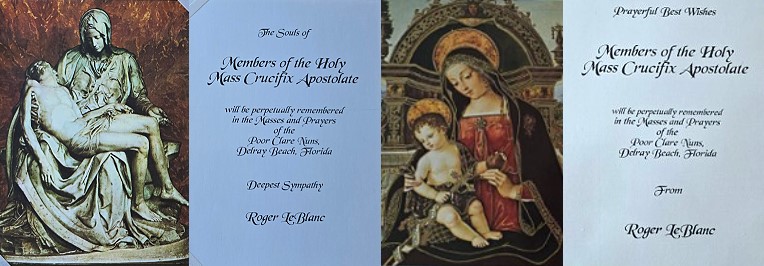
The Holy Mass Crucifix Apostolate has also been entrusted to the prayers of the Poor Clare Nuns of Christ the King Monastery in Delray Beach, Florida.
Both living and deceased members of the Holy Mass Crucifix Apostolate are perpetually remembered in the Masses and Prayers of the Poor Clare Nuns, adding another deeply meaningful spiritual dimension to the apostolate and its Eucharistic mission.
Together with the Apostolic Blessing of Pope Benedict XVI, these prayers have accompanied the Holy Mass Crucifix Apostolate throughout its mission of drawing souls toward Jesus Christ and His Real Presence in the Holy Eucharist.
BE REMEMBERED IN PERPETUAL PRAYER
Those who wish to become members of the Holy Mass Crucifix Apostolate may request to be included among its members.
Members of the Apostolate are included in the intention entrusted to the Poor Clare Nuns of Delray Beach, Florida, whose Masses and prayers perpetually remember the living and deceased members of the Holy Mass Crucifix Apostolate.
There is no charge to become a member. Membership is simply an invitation to share in the spiritual mission of the Holy Mass Crucifix Apostolate and its devotion to Jesus Christ in the Most Holy Eucharist.
A CRUCIFIX FOR THE CATHOLIC HOME
The Holy Mass Crucifix is intended to be more than a religious decoration. It is a visual reminder of the mystery at the very heart of the Catholic Faith.
Displayed in the home, it reminds the family that the Jesus whom we adore in the Holy Eucharist is the same Jesus who offered Himself upon Calvary for our salvation.
Its purpose is to encourage prayer, reverence for the Blessed Sacrament, and a deeper appreciation of what takes place upon the altar at every Holy Mass.
A VISIBLE TEACHING OF THE FAITH
The Holy Mass Crucifix was designed so that its meaning can be understood visually. Each element helps tell the story of Christ's Sacrifice and its relationship to the Holy Eucharist.
Parents and grandparents can use the Crucifix to help children understand why the Mass is a sacrifice, why Catholics adore Jesus in the Blessed Sacrament, and why Calvary and the altar can never be separated.
In this way, the Holy Mass Crucifix can become both an object of devotion and a simple means of passing the Catholic Faith from one generation to the next.
INTERCHANGEABLE MEDALLIONS
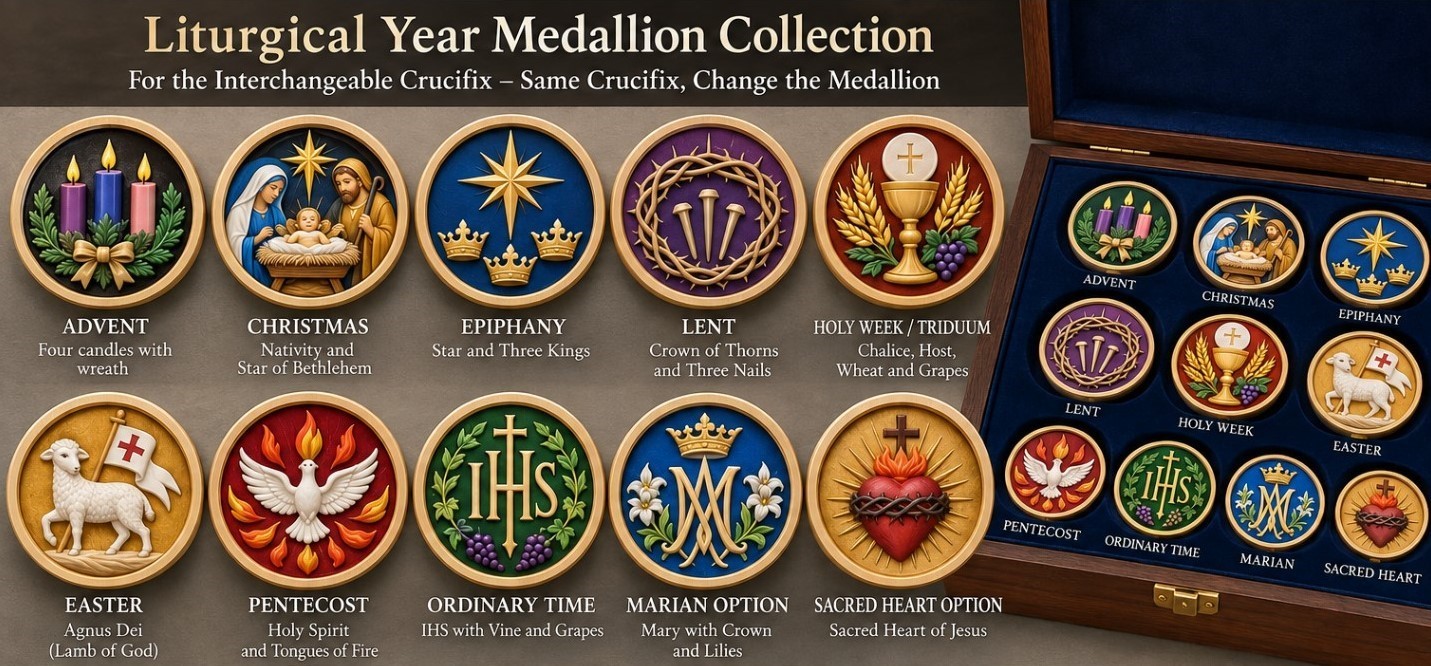
Beginning with the 6-inch Holy Mass Crucifix, the medallion can be changed, allowing the same Crucifix to be adapted for different seasons, occasions and devotions.
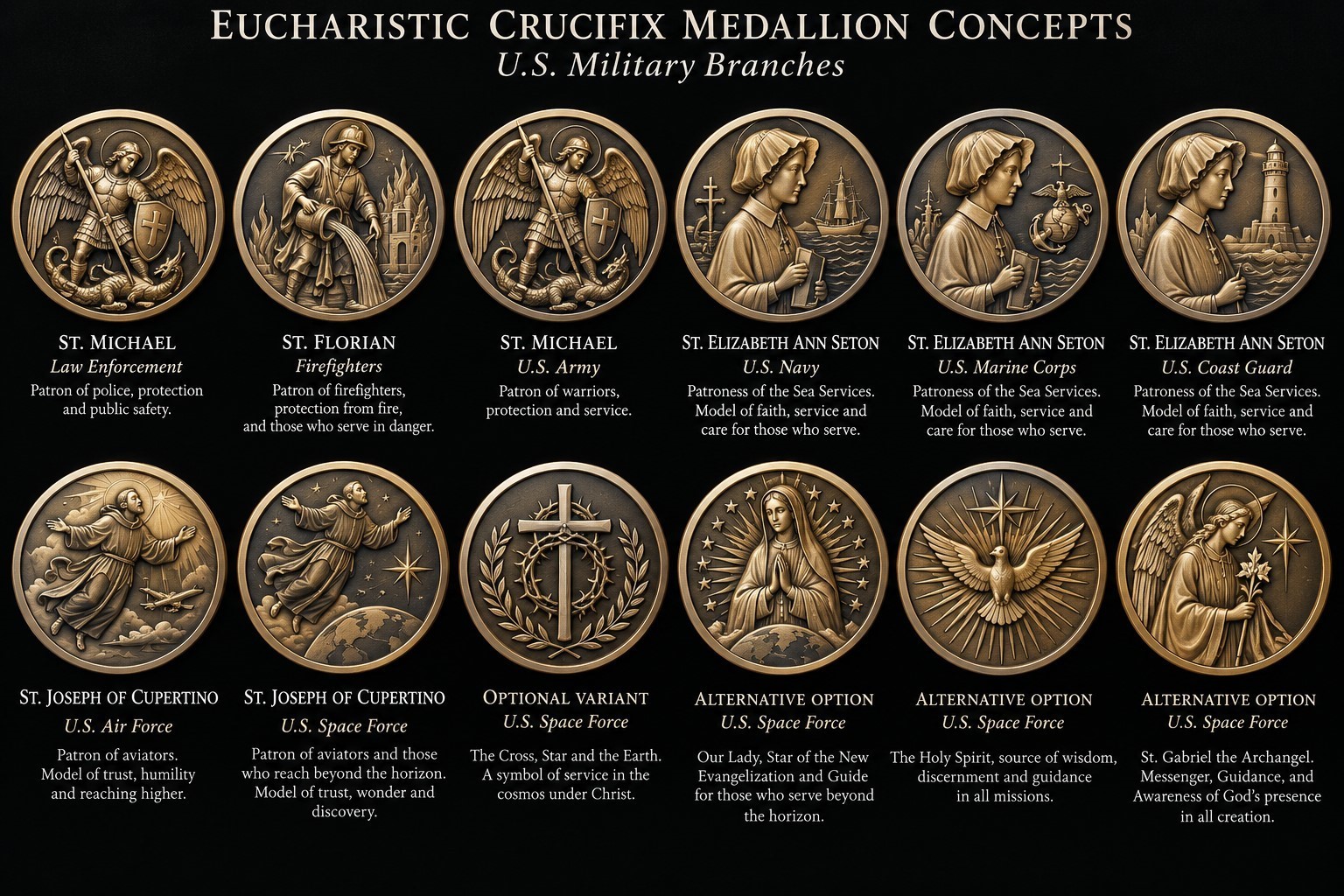
Special medallion collections are planned for the liturgical year, including Christmas and other major seasons and feasts of the Church. Additional medallions can honor particular devotions and vocations, including military, police and firefighter designs.
The medallions are designed to be easily changed from the back while preserving the appearance of the Crucifix from the front. This allows one Holy Mass Crucifix to take on special meaning throughout the year without changing its central message of Calvary and the Holy Eucharist.
Unlike the larger Crucifixes, its medallion is permanently installed. The wearer may select a devotional or service medallion when ordering, creating a Crucifix with particular personal meaning.
Special versions are planned for members of the military, police officers and firefighters, combining the Eucharistic symbolism of the Holy Mass Crucifix with a medallion representing their service.
PLANNED MEDALLION COLLECTIONS
Examples of planned interchangeable medallions for the Holy Mass Crucifix.
DESIGNED FOR THE FUTURE
The medallions shown above represent planned designs and collections for the Holy Mass Crucifix. Individual designs may be refined as the collection is developed.
Because the 6-inch and larger Holy Mass Crucifixes are designed to accept interchangeable medallions, new devotional, liturgical and commemorative designs can be introduced in the future without requiring a new Crucifix.
This makes the Holy Mass Crucifix a devotional piece that can remain with a Catholic family for years while its medallion changes with the seasons of the Church, special occasions and personal devotions.
WORN OVER THE HEART
THE WEARABLE HOLY MASS CRUCIFIX — IN DEVELOPMENT - The wearable Holy Mass Crucifix is intended to be worn over the heart. This is not merely a convenient place to wear a pendant. In Sacred Scripture, the heart signifies more than a physical organ; it is the interior center of the person — the place of love, faith, desire, sacrifice and communion with God. The position of the Holy Mass Crucifix over the heart is therefore itself part of its message.
First, the wheat and grapes speak of sacrifice. Christ used the image of the grain of wheat that must fall to the earth and die in order to bear fruit. Grapes likewise must pass through the winepress to produce wine. Upon the Holy Mass Crucifix, the wheat and grapes point toward the Passion of Jesus Christ, who gave Himself for our salvation. They also speak of the Christian life, in which we are called, in imitation of Christ, to die to self in love and service of others within His Mystical Body, the Church.
Second, the wheat and grapes speak of the Priesthood of Christ. At every Holy Mass, Christ continues to take the elements of bread and wine, which come from wheat and grapes, through the hands of His priest. Through the words of consecration, Christ makes His Body and Blood present upon the altar. The priest acts in the person of Christ, the Eternal High Priest.
Third, worn over the heart, the Holy Mass Crucifix signifies the indwelling of the Holy Trinity. At the Last Supper, in His great colloquy of love, Jesus revealed an extraordinary reality: “If anyone loves Me, he will keep My word, and My Father will love him, and We will come to him and make Our home with him” (John 14:23).
The heart, understood in its full Scriptural sense, is the interior sanctuary of the person. Through the life of grace, the Father, the Son and the Holy Spirit come to dwell within us. Thus, when the Holy Mass Crucifix is worn over the heart, its outward position signifies this profound interior reality: the heart becomes a dwelling place of the Holy Trinity — a throne of God within the person.
Fourth, wearing the Holy Mass Crucifix over the heart expresses our union with the death and life of Jesus Christ. St. Paul speaks of “always carrying in the body the death of Jesus, so that the life of Jesus may also be manifested in our body” (2 Corinthians 4:10). The Christian is called not merely to look upon the Cross, but to live the mystery of the Cross by uniting his own sacrifices and sufferings with those of Christ.
St. Paul expresses this mystery again when he rejoices in his sufferings for others and speaks of completing in his flesh “what is lacking in Christ's afflictions for the sake of His body, that is, the Church” (Colossians 1:24). Nothing is lacking in the saving power of Christ's Sacrifice; rather, Christ permits the members of His Mystical Body to unite their sufferings with His for the good of others.
For this reason, wearing the Holy Mass Crucifix over the heart becomes a visible expression of love: Christ's love for us, our love for Him, and the sacrificial love we are called to have for one another as members of His Mystical Body.
In this way, the Holy Mass Crucifix opens almost like a book. In one visual image it speaks of Calvary, the Holy Sacrifice of the Mass, the Holy Eucharist, the Priesthood of Christ, the indwelling of the Holy Trinity, and the Christian's participation in the Mystical Body of Christ.
Worn visibly, it can also open the door to conversations about the Catholic Faith with those who are still searching for the Lord.
CRAFTED WITH PURPOSE
The Holy Mass Crucifix is being developed with careful attention to both its religious symbolism and the quality of its construction.
The 6-inch and larger Crucifixes are planned in genuine wood, with each component carefully fitted so that the Eucharistic imagery, the Corpus of Christ and the interchangeable medallion become part of one unified design.
The smaller wearable Holy Mass Crucifix is being developed in metal, with the Crucifix and Corpus formed as one integral piece and the selected devotional or service medallion permanently installed.
FOR HOME, CHURCH AND GIFT-GIVING
The Holy Mass Crucifix is being created for Catholics who desire a constant visual reminder of the relationship between Calvary, the Holy Eucharist and the Holy Sacrifice of the Mass.
The larger Crucifixes are suitable for Catholic homes and other appropriate devotional settings, while the smaller metal Crucifix can be worn as a personal expression of faith and devotion.
The Holy Mass Crucifix may also become a meaningful Catholic gift for occasions such as First Holy Communion, Confirmation, marriage, ordination, anniversaries and other important moments in the life of faith.
THE PRIEST — ALTER CHRISTUS
At the Holy Sacrifice of the Mass, the priest stands at the altar as alter Christus — “another Christ” — acting in the person of Christ.
When he speaks the words of consecration, it is Christ Himself who acts through the ministry of the priest. The sacrifice offered upon the altar is therefore not a new sacrifice, but the one Sacrifice of Jesus Christ upon Calvary made sacramentally present.
The priest, the altar, the Eucharist and the Crucifix all direct our attention to the same reality: Jesus Christ, the Eternal High Priest, offering Himself for the salvation of the world.
THE MISSION CONTINUES
The mission of the Holy Mass Crucifix Apostolate is ultimately not about the Crucifix itself. It is about Jesus Christ and helping souls better understand the mystery of His Sacrifice and His Real Presence in the Holy Eucharist.
If the Holy Mass Crucifix causes someone to look more attentively toward the altar, approach the Blessed Sacrament with greater reverence, or understand more deeply what takes place at the Holy Sacrifice of the Mass, then it has fulfilled its purpose.
May every Holy Mass Crucifix point beyond itself to Jesus Christ — Crucified, Risen, and truly present in the Most Holy Eucharist.
DISCOVER THE HOLY MASS CRUCIFIX
Explore the Holy Mass Crucifix collection, including the larger handcrafted wooden Crucifixes, interchangeable medallion designs, and the planned wearable metal Crucifix.
Each is created with one purpose: to turn our hearts and minds toward Jesus Christ, Calvary, and His Real Presence in the Most Holy Eucharist.